
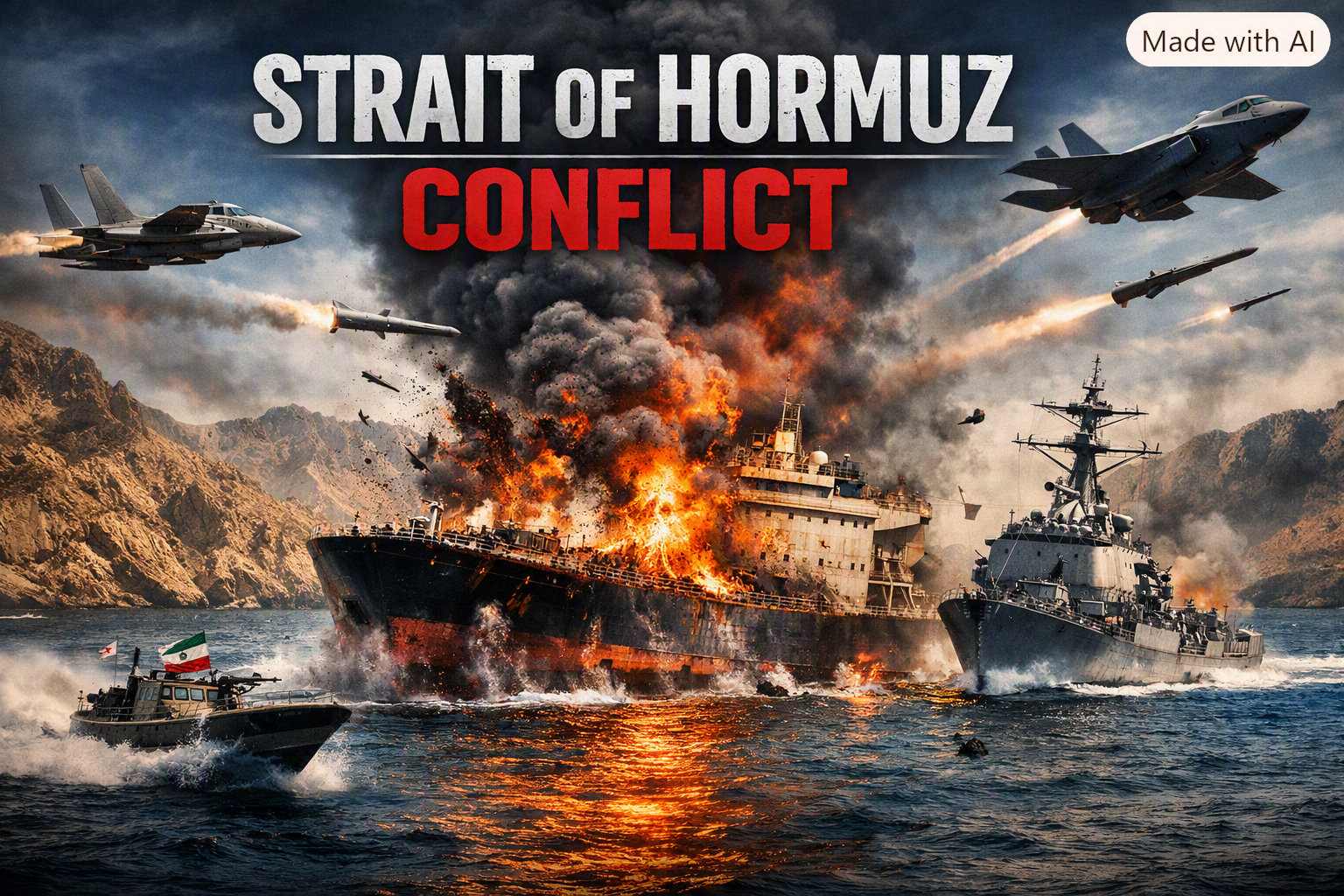
The strait of Hormuz is a narrow but immensely powerful waterway. It connects the Persian Gulf to the Gulf of Oman and the Arabian Sea. At its tightest point, it is only thirty-three kilometers wide.
Yet through this narrow passage flows nearly one-fifth of the world’s traded oil. A fifth of global liquefied natural gas moves through it. Every tanker that passes through carries the lifeblood of economies from Asia to Europe.
Its importance is magnified by the fact that most Gulf nations—Saudi Arabia, Iraq, Kuwait, Qatar, the United Arab Emirates, and Iran—depend on it for access to international markets. Any disruption here reverberates instantly across continents, causing prices to rise and insurance premiums to spike.
⚡ Historical Context: A Chokepoint Under Pressure
The strait has long been a stage for conflict. During the Iran‑Iraq war in the 1980s, both sides targeted tankers. This created what became known as the Tanker War concluding with Operation Praying Mantis. In 2019, a series of mysterious attacks on vessels reignited fears of closure. Additionally, each incident reminded the world that this narrow passage is exposed to geopolitical storms. Moreover, the United States maintains a strong naval presence in Bahrain to secure shipping lanes. Iran, controlling the northern shore, has repeatedly threatened closure during times of tension. This duality—protection on one side, pressure on the other—makes Hormuz a perpetual flashpoint. It is a place where energy security and military rivalry intersect.
📅 Sequence of Events: The 2026 West Asia Conflict
The year 2026 brought the most severe disruption in decades. The conflict in West Asia unfolded in stages. Each stage tightened the grip on Hormuz. Each stage amplified the shockwaves across global markets.
February 2026 – Outbreak of War By late February, hostilities erupted between Iran, Israel, and U.S. forces. Skirmishes quickly escalated into strikes on infrastructure. Shipping through Hormuz slowed. Tankers hesitated. Insurance companies raised premiums. The first signs of paralysis appeared.
March 2026 brought refinery strikes and a supply shock. Bahrain’s Sitra refinery was hit. The UAE’s Ruwais complex shut down. Qatar’s Ras Laffan GTL plant suffered damage. These strikes crippled regional refining capacity. The International Energy Agency released four hundred million barrels from reserves. This helped calm markets. Brent crude surged past $120. Investors watched markets closely. Asia felt the shock most acutely. India, China, Japan, and South Korea faced immediate shortages. Inflationary pressures mounted. The strait of Hormuz became a bottleneck of fear.
April 2026 saw a naval blockade and ceasefire attempts. Despite efforts, shipping remained stalled across the region. The United States imposed a blockade on Iranian ports to pressure compliance. Diplomats urged restraint while commercial talks lagged. Authorities warned of possible escalation.
Only 191 vessels transited the strait of Hormuz, compared with a pre-war monthly average of around 3,000. The disruption was unprecedented, and strategic reserves were tapped again. Yet the strait remained effectively closed. Monitoring reports noted continued risk to shipping lanes.
May 2026 – Escalation and Shadow Fleet May saw escalation. Missile incidents near Bandar Abbas raised tensions. U.S. forces disabled Iranian tankers. Turkey reopened the Iraq–Turkey pipeline to bypass Hormuz. A shadow fleet of “ghost ships” tried to evade sanctions. But volumes remained low. By the end of May, the blockade was lifted. Still, the strait did not reopen fully. Fear lingered. Markets remained volatile.
June to August 2026 marked stalemate and diplomatic strain. The summer months saw ceasefires collapse and Lebanon’s front reopen. Negotiations stalled over routing disputes as Iran pressed territorial waters. Oman advocated the IMO‑approved route while others insisted on alternate passages.
By early August, the conflict had lasted one hundred fifty-nine days. Brent crude stabilized near eighty‑eight dollars per barrel, yet volatility persisted. Thousands of vessels remained stranded. The strait of hormuz remained a focal chokepoint. Policy discussions continued in capitals and at regional forums.
Overall, the situation remained unresolved as regional tensions persisted. Vessel movements were slower, market volatility lingered, and neutral shipping lanes stayed under scrutiny. Coordination efforts continued quietly among regional actors and international observers. The international community urged restraint while monitoring maritime traffic and potential enforcement actions.
📊 Impact on Global Energy and Trade
The impact was immediate and severe. Oil prices spiked. Liquefied natural gas flows collapsed. Insurance costs soared. Freight rates multiplied. Asian economies bore the brunt. India faced fuel shortages. China scrambled for alternative supplies. Japan and South Korea struggled with rising import bills. Europe felt the ripple through inflation. The United States tapped its Strategic Petroleum Reserve multiple times. Yet the shock could not be fully absorbed. The closure of Hormuz was a reminder that no alternative route can match its scale. Pipelines through Saudi Arabia and Turkey helped but capacity was limited. The world remained vulnerable.
🛡️ Geopolitical Dimensions
The conflict highlighted the geopolitical fragility of the strait. Iran used its northern shoreline as leverage. The United States deployed naval power to secure passage. Gulf states watched anxiously, aware that their economic survival depended on reopening. Israel’s involvement added another layer of complexity. Regional rivalries deepened. Global powers were drawn in. The Strait of Hormuz became not just a maritime chokepoint but a symbol of geopolitical contest. Its closure was not merely an economic event. It was a strategic confrontation.
🔮 Future Outlook
The future of the Strait of Hormuz remains uncertain. Diplomatic negotiations may eventually reopen the lanes. Alternative pipelines may reduce dependence. Yet the strait will remain central. Its geography cannot be bypassed entirely. Its role as a chokepoint is permanent. The 2026 conflict proved that closure is possible. It proved that markets are vulnerable. It proved that energy security is fragile. The world must prepare for future disruptions. Strategic reserves, diversified routes, and diplomatic engagement are essential. But the Strait of Hormuz will always be the heartbeat of global energy trade.
📌 Conclusion
The Strait of Hormuz is more than a waterway. It is the narrow passage through which the world’s energy flows. The 2026 West Asia conflict showed how quickly this lifeline can be strangled. The sequence of strikes, blockades, and stalemates created the sharpest energy shock in decades. Prices soared. Vessels stranded. Economies trembled. The strait’s importance is undeniable. Its vulnerability is unavoidable. For SEO content, emphasizing its strategic, economic, and geopolitical dimensions ensures relevance. For the world, securing its openness remains a matter of survival.
2 thoughts on “The Strait of Hormuz: Essential Energy Lifeline and West Asia Flashpoint”