Digital India has transformed India into the world’s largest digital public infrastructure ecosystem, with UPI handling nearly 49% of global real‑time transactions, broadband subscribers rising 400% in a decade, and digital services now contributing 12–14% of GDP. This article explores the Digital India Growth Story in depth — achievements, challenges, and future directions.
Digital India at 11 Years
Launched in 2015, the Digital India program has completed 11 years in 2026, reshaping how citizens connect, transact, and access services. From Aadhaar‑enabled identity to UPI payments, from BharatNet broadband highways to DigiLocker, Digital India has become the backbone of India’s digital economy.
🚀 Achievements of Digital India
1. Digital Payments Revolution
- UPI powers 81% of India’s digital payments and nearly 49% of global real‑time transactions.
- Over 46 crore users and 685 banks integrated.
- Monthly transaction value exceeds ₹18 lakh crore.
2. Broadband and Connectivity
- Broadband subscribers grew from 25 crore (2015) to 103 crore (2025) — a 400% increase.
- Optical fiber laid: 6.9 lakh km, up from just 358 km in 2014.
- Nearly 97% of Gram Panchayats connected under BharatNet.
3. Affordable Internet Access
- Average monthly data consumption rose from 61 MB (2014) to 25 GB (2025).
- Cost of data fell 97%, from ₹269/GB to ₹7.9/GB.
4. Digital Governance Platforms
- DigiLocker: 67 crore users, 967 crore documents issued.
- UMANG App: 10.5 crore users, 741 crore transactions.
- Direct Benefit Transfers (DBT): ₹49.8 lakh crore transferred via JAM Trinity (Jan Dhan, Aadhaar, Mobile).
5. Digital Economy Contribution
- Digital economy contributes 12–14% of GDP.
- Expected to reach 20% by 2035.
💡 Opinion and Analysis
Strengths
- Inclusion: Rural India connected through BharatNet.
- Efficiency: DBT reduced leakages in subsidies.
- Global Leadership: India Stack exported to other countries.
Challenges
- Digital Divide: Despite progress, 20% of villages still lack reliable internet.
- Cybersecurity Risks: Rising digital adoption increases vulnerability.
- Data Privacy: Aadhaar and UPI raise concerns about surveillance.
🌍 Global Perspective
India’s Digital Public Infrastructure (DPI) is now a global model. Countries in Africa and Asia are adopting India Stack. The World Bank and UN have praised India’s leadership in inclusive digital governance.
Digital India Programme & India’s Startup ecosystem
One of the most remarkable outcomes of the Digital India program has been the rise of India’s startup ecosystem, now the third largest in the world after the US and China.
📈 Key Achievements
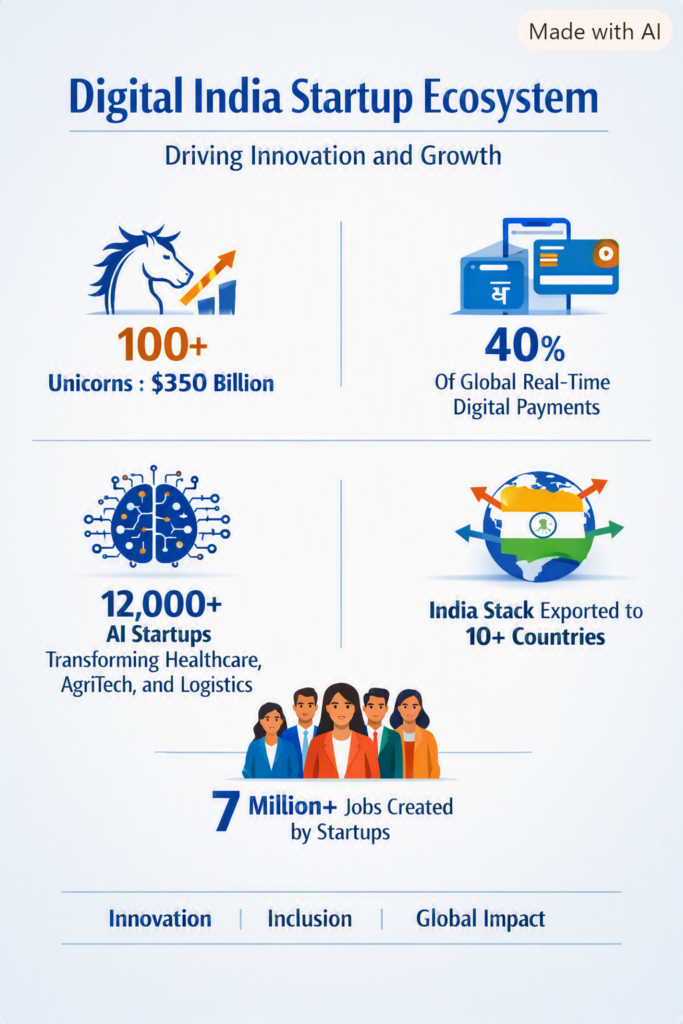
- 100+ unicorns valued collectively at USD 350 billion.
- Fintech dominance: India accounts for 40% of global real‑time digital payments, with startups like PhonePe, Paytm, and Razorpay leading innovation.
- AI and Deep Tech: Over 12,000 AI‑focused startups registered by 2026, working in healthcare, agriculture, and logistics.
- Government support: Schemes like Startup India, Digital India Fund, and SIDBI Fund of Funds have mobilized billions in venture capital.
💡 Sectoral Impact
- Fintech: UPI and Aadhaar‑enabled KYC have lowered entry barriers.
- EdTech: Platforms like Byju’s and Unacademy scaled digital learning to rural India.
- AgriTech: Startups using IoT and AI for crop monitoring, boosting farmer incomes.
- HealthTech: Telemedicine and AI diagnostics expanded access to healthcare.
🌍 Global Recognition
India’s digital startups are now exporting solutions abroad. The India Stack (UPI, Aadhaar, DigiLocker) has been adopted in countries like Philippines, Kenya, and Singapore, positioning India as a global leader in digital public infrastructure.
🧠 Analytical Perspective
Digital India’s startup boom is not just about numbers — it reflects a structural shift in India’s economy:
- Job Creation: Startups have generated over 7 million direct and indirect jobs.
- Financial Inclusion: Digital lending platforms have extended credit to 50 million first‑time borrowers.
- Innovation Culture: India’s youth are driving solutions for local problems, from rural logistics to renewable energy.
However, challenges remain:
- Funding Winter: Global economic slowdown has reduced venture capital inflows.
- Regulatory Uncertainty: Data protection laws and fintech regulations need clarity.
- Digital Divide: Rural startups still face infrastructure gaps.
📊 Updated Snapshot of Digital India (Including Startups)
| Indicator | 2015 | 2026 | Growth |
|---|---|---|---|
| Unicorn Startups | 0 | 100+ | Massive rise |
| Startup Valuation | USD 15 Bn | USD 350 Bn | +2200% |
| AI Startups | <500 | 12,000+ | Explosive |
| UPI Transactions | 0 | ₹18 Lakh Cr/month | Global leader |
| Broadband Subscribers | 25 Cr | 103 Cr | +400% |
| DigiLocker Users | 0 | 67 Cr | Nationwide adoption |
✅ Conclusion: Digital India as the Startup Nation
Digital India has not only connected citizens but also unleashed entrepreneurial energy. By combining public digital infrastructure with private innovation, India has created a model admired worldwide. As India moves toward Viksit Bharat 2047, startups will be the engines of growth, ensuring that Digital India remains both inclusive and globally competitive.
Follow FreeStrikes for more insights on India’s policy shifts.
1 thought on “Digital India: Empowering Citizens and Driving Growth”