Introduction
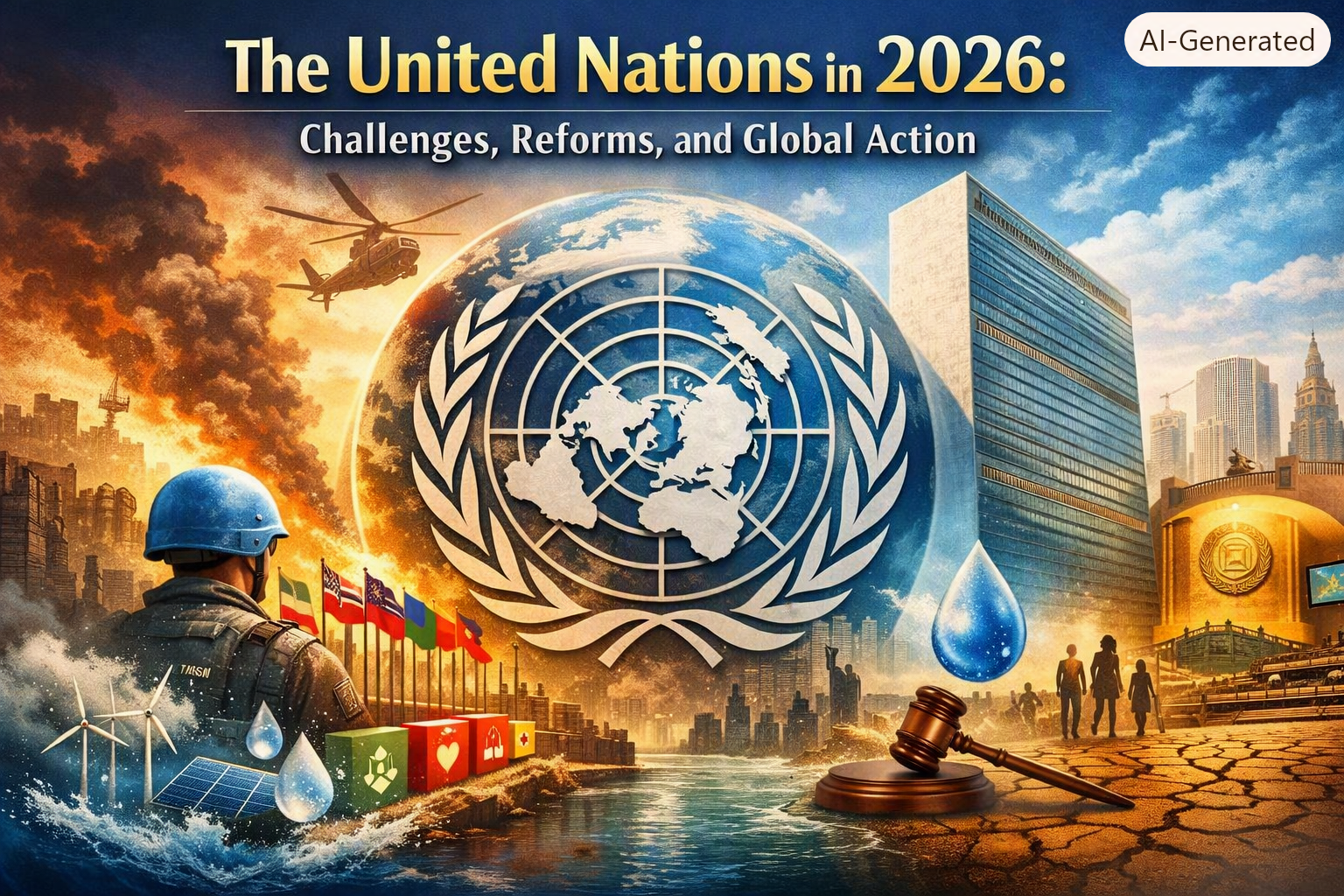
The United Nations in 2026 continues to serve as the world’s largest multilateral organization, tasked with maintaining peace, advancing sustainable development, and protecting human rights. In 2026, the UN faces critical challenges: accelerating progress on the 2030 Agenda for Sustainable Development, addressing global conflicts, and preparing for landmark conferences on water and climate.
🏛️ Sustainable Development Goals (SDGs)
- The High‑Level Political Forum on Sustainable Development (July 2026) concluded with a ministerial declaration urging urgent action to meet the 2030 Agenda.
- Current progress: only 36% of SDG targets are on track, with major gaps in water, energy, and infrastructure.
- UN Secretary‑General António Guterres emphasized that “multilateralism continues to deliver results, but must accelerate.”
🔗 UN Meetings Coverage – HLPF 2026 (press.un.org in Bing)
💧 Upcoming United Nations in 2026 Water Conference
Scheduled for 8–10 December 2026 in Abu Dhabi, UAE, co‑hosted by Senegal and the UAE.
- Focus: SDG 6 — Clean Water & Sanitation, global water security, and sustainable resource management.
- This is the first major follow‑up since the historic 2023 UN Water Conference.
🔗 UN DESA – UN Water Conference 2026 (sdgs.un.org in Bing)
🏛️ UN General Assembly Highlights (July 2026)
- Road Safety Declaration (20 July 2026): Governments recommitted to halving global road traffic deaths by 2030, calling crashes a “silent pandemic.”
- Urbanization Declaration (16 July 2026): Adopted a political declaration to accelerate the New Urban Agenda, noting 3 billion people lack adequate housing.
- Universal Health Coverage (10 July 2026): Decided modalities for the 2027 high‑level meeting on affordable healthcare for all.
🔗 United Nations in 2026 General Assembly Resolutions – July 2026 (press.un.org in Bing)
⚖️ UN Security Council Agenda (July 2026)
- Presidency: Democratic Republic of the Congo chaired the Council in July.
- Key Debates:
- Natural Resource Governance (22 July 2026) — linking resource management to peace and security.
- Conflict‑Related Sexual Violence (8 July 2026) — reaffirming survivor rights under international law.
- Middle East & Lebanon — ongoing consultations on Resolution 1701 and regional stability.
- Haiti & Syria — updates on elections, gang violence, and humanitarian crises.
🔗 UN Security Council Programme of Work – July 2026 (press.un.org in Bing)
🌐 Changing Global Perspectives on the United Nations
In 2026, global attitudes toward the United Nations are shifting amid renewed debates on its relevance and reform. U.S. President Donald Trump, who returned to office earlier this year, has called for a “results‑driven United Nations” and urged member states to share greater financial responsibility for peacekeeping and humanitarian programs. His administration’s stance has reignited discussions on institutional efficiency and sovereignty within multilateral frameworks. Meanwhile, emerging powers such as India, Brazil, and South Africa continue to advocate for UN Security Council reform, seeking permanent representation to reflect modern geopolitical realities. As nations reassess their roles, the UN faces a defining moment — balancing traditional diplomacy with the need for structural transformation to remain effective in a rapidly evolving world.
🔗 Reference: UN Press Release – Security Council Reform Debate, July 2026 (bing.com in Bing)
✍️ Conclusion
The United Nations in 2026 stands at a crossroads:
- Peace & Security: Managing conflicts in the Middle East, Africa, and Haiti.
- Development: Accelerating SDGs before the 2030 deadline.
- Climate & Water: Preparing for the Abu Dhabi Water Conference to secure global resources.
Despite challenges, the United Nations in 2026 remains indispensable — a forum where nations must cooperate to solve problems no country can tackle alone.