
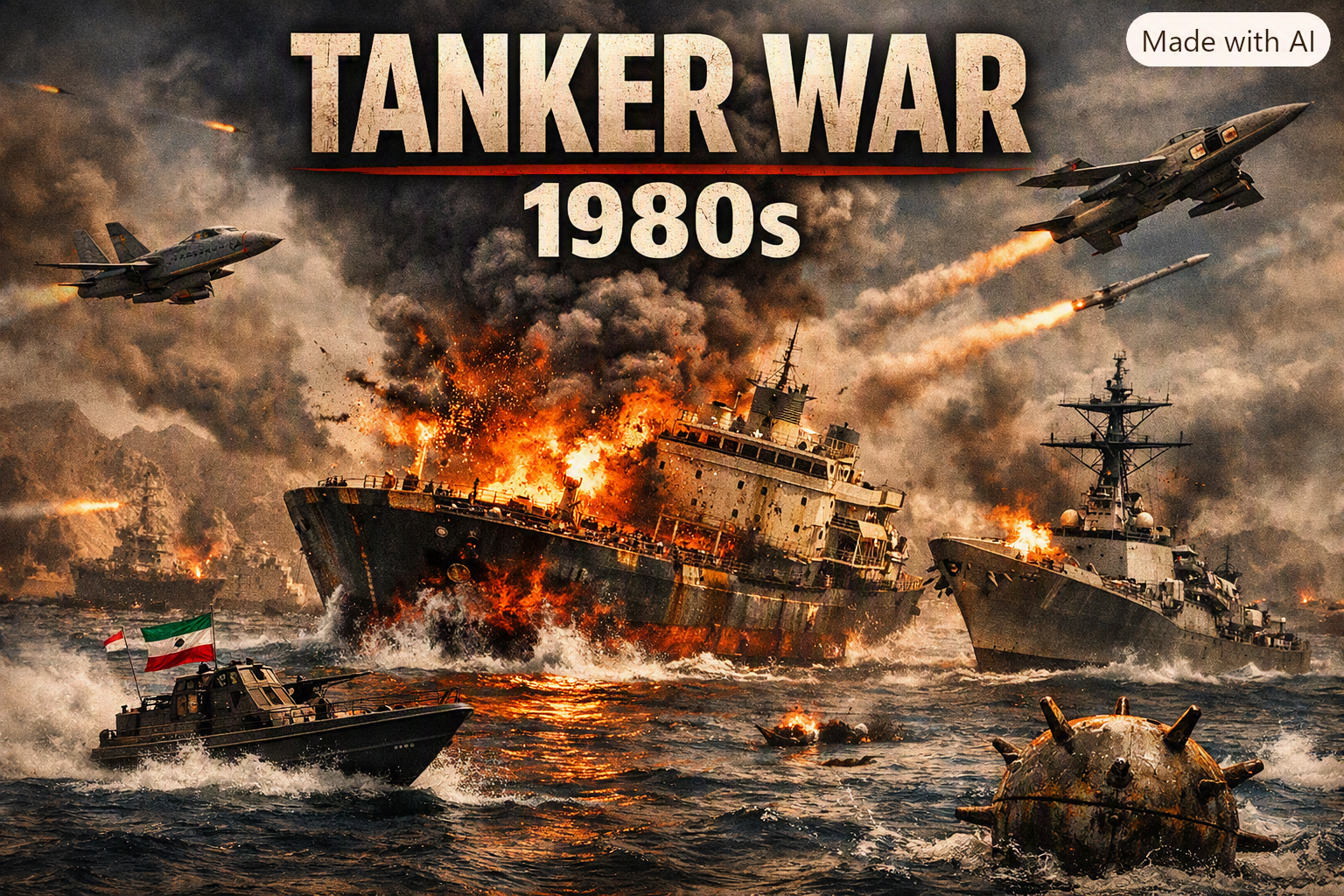
🚢 The Tanker War of the 1980s: Oil, Conflict, and the Strait of Hormuz
The Tanker War Strait of Hormuz was one of the most dangerous maritime conflicts of the late twentieth century.
It unfolded during the Iran–Iraq War (1980–1988) and turned the Strait of Hormuz into a battlefield.
This narrow waterway, already the world’s most vital oil chokepoint, became the stage for attacks on tankers.
It also featured naval skirmishes and international intervention.
🌍 Background: The Iran–Iraq War and the Gulf’s Vulnerability
The Iran–Iraq War began in September 1980. It was a brutal land conflict, but by 1984 it spilled into the waters of the Persian Gulf. Both nations sought to cripple each other’s economies by targeting oil exports. The Strait of Hormuz, through which most Gulf oil flowed, became the natural target. This period is often called the Tanker War Strait of Hormuz. Tankers carrying crude from Kuwait, Saudi Arabia, and other Gulf states were attacked. Insurance premiums skyrocketed. Global oil prices trembled. The world realized that a regional war could instantly become a global crisis.
📅 Sequence of Events in the Tanker War
1984 – Opening Shots Iraq began attacking Iranian oil tankers and terminals. Iran retaliated by striking ships linked to Iraq’s allies, especially Kuwait and Saudi Arabia. The Gulf became a war zone. Neutral vessels were not spared.
1985–1986 – Escalation Attacks intensified. Mines were laid in shipping lanes. Missiles targeted tankers near Hormuz. Insurance costs soared. Many shipping companies hesitated to send vessels through the Gulf. The global oil market grew nervous.
1987 – U.S. Intervention Kuwait requested protection. The United States re-flagged Kuwaiti tankers under the American flag. U.S. warships escorted them through Hormuz. This marked direct American involvement. Skirmishes followed. In April 1988, the U.S. Navy destroyed much of Iran’s fleet in Operation Praying Mantis after the frigate USS Samuel B. Roberts struck an Iranian mine.
1988 – Ceasefire and Aftermath By mid‑1988, both Iran and Iraq were exhausted. The UN brokered a ceasefire. The Tanker War ended, but its legacy endured. The Strait of Hormuz had proven itself the most vulnerable artery of global trade.
⚡ Impact on Global Energy and Trade
The Tanker War disrupted oil flows. Hundreds of vessels were damaged or sunk. Insurance premiums multiplied. Freight costs rose sharply. Oil prices spiked, though global reserves and alternative supplies helped stabilize markets. The war forced Gulf states to consider pipelines bypassing Hormuz. It also cemented the U.S. role as the Gulf’s security guarantor. For Asia, Europe, and the U.S., the war was a reminder that energy security depends on a narrow passage vulnerable to regional conflict.
🛡️ Geopolitical Dimensions
The Tanker War was not just about oil. It was about power. Iraq sought to weaken Iran’s economy. Iran retaliated by striking Iraq’s allies. The U.S. entered to protect its interests and allies. The Soviet Union watched closely. The Gulf monarchies feared for their survival. The Strait of Hormuz became the focal point of Cold War geopolitics. It was a regional war with global implications.
🔮 Future Outlook
The Tanker War of the 1980s set a precedent. It showed that the Strait of Hormuz is always at risk. Later crises—from the 2019 tanker attacks to the 2026 West Asia conflict—echoed its lessons. Energy security remains fragile. Global markets remain vulnerable. The strait remains the heartbeat of oil trade and the pressure point of geopolitics.
📌 Conclusion
The Tanker War was a brutal reminder of how fragile global energy flows are. The sequence of attacks, naval battles, and international intervention turned the Strait of Hormuz into a war zone. Oil prices rose. Shipping costs multiplied. Economies trembled. The war ended, but its lessons endure. For the world, securing Hormuz remains a matter of survival.
3 thoughts on “The Essential 1980s Tanker War: Oil and Hormuz”