
Who was Mahatma Gandhi?
Mahatma Gandhi’s role in India’s independence is undisputed — he mobilized millions through non‑violence and truth. Yet, Mahatma Gandhi was not universally accepted. His ideas were challenged by right‑wing cultural nationalists, left‑wing revolutionaries and socialists, and even centrist pragmatists within the Congress. Understanding Gandhi requires examining his movements, philosophy, and the ideological clashes that shaped India’s freedom struggle.
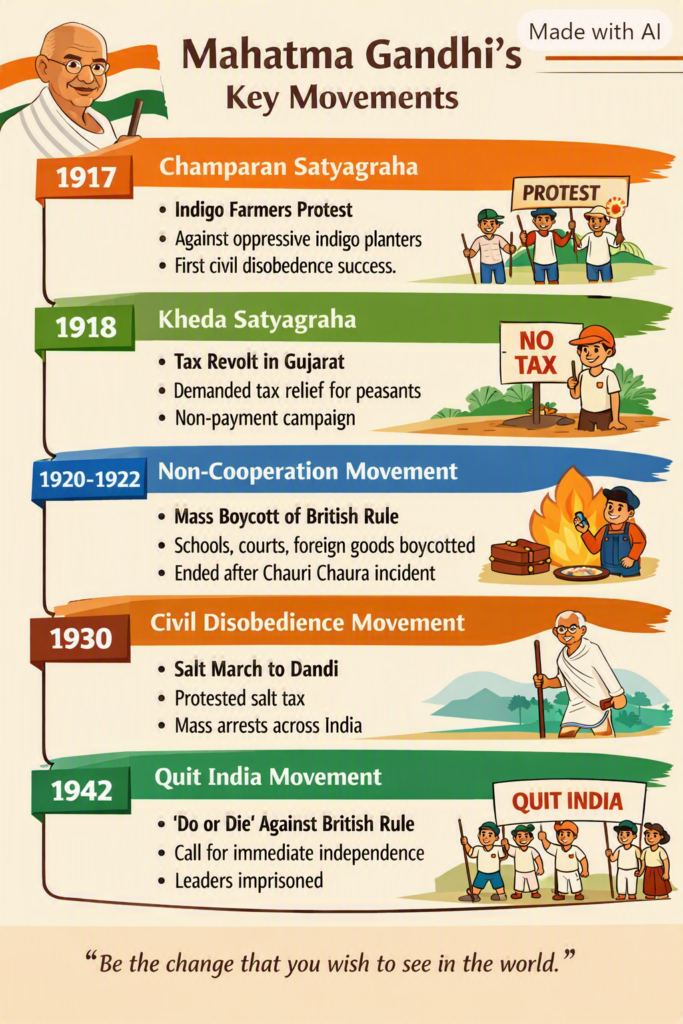
Mahatma Gandhi Movements in Detail
Champaran Satyagraha (1917)
- Farmers forced to grow indigo under exploitative contracts.
- Gandhi organized peasants, demanded justice.
- Outcome: Planters refunded illegal dues — India’s first successful civil disobedience.
Kheda Satyagraha (1918)
- Crop failure, peasants unable to pay taxes.
- Gandhi led non‑payment campaign.
- British relented, granting remission.
Non‑Cooperation Movement (1920–22)
- Triggered by Jallianwala Bagh massacre and Khilafat issue.
- Boycott of schools, courts, foreign goods.
- Millions joined; imports of British cloth halved.
- Suspended after Chauri Chaura violence (1922).
Civil Disobedience Movement (1930–34)
- Salt March (1930): Gandhi walked 240 miles to Dandi, breaking salt law.
- Sparked nationwide protests; 60,000 arrested.
- Gandhi‑Irwin Pact allowed peaceful protest.
- Though partial, it delegitimized British rule.
Quit India Movement (1942)
- WWII context; Gandhi’s call: “Do or Die.”
- Leaders jailed, underground resistance spread.
- Though suppressed, it convinced Britain independence was inevitable.
🧭 Mahatma Gandhi Philosophy
- Satya (Truth): Politics must rest on moral truth.
- Ahimsa (Non‑Violence): Resistance without hatred.
- Swaraj: Self‑rule, both political and personal discipline.
- Sarvodaya: Welfare of all.
- Trusteeship: Wealth held in trust for society.
⚖️ Criticisms of Mahatma Gandhi
Left‑Wing Critiques of Mahatma Gandhi
- Bhagat Singh, Bose, Communists: Felt Mahatma Gandhi slowed independence by rejecting armed struggle.
- Socialists: Criticized Gandhi’s village‑centric economy as impractical.
- Ambedkar: Accused Gandhi of defending caste through varna system; Poona Pact seen as limiting Dalit autonomy.
Right‑Wing Critiques
- Cultural nationalists opposed Gandhi’s insistence on Hindu‑Muslim unity.
- His fasts for communal harmony were seen as appeasement.
- Gandhi’s universalism clashed with majoritarian identity politics.
Centrist Critiques
- Within Congress, leaders like Vallabhbhai Patel and Rajendra Prasad sometimes disagreed with Gandhi’s uncompromising non‑violence.
- Pragmatists argued for stronger negotiation with Britain rather than moral resistance alone.
🌍 Mahatma Gandhi vs India’s Ideological Wings
Right Wing
- Advocated cultural nationalism and majority identity.
- Saw Gandhi’s insistence on Hindu‑Muslim unity as weakening Hindu assertion.
- His assassination in 1948 reflected extremist anger at his communal harmony stance.
Left Wing
- Advocated socialism, revolution, and class struggle.
- Saw Gandhi’s non‑violence as inadequate against colonial exploitation.
- Ambedkar’s critique of Gandhi on caste remains a cornerstone of leftist thought.
Center
- Congress centrists balanced Gandhi’s ideals with pragmatic politics.
- They valued his mass mobilization but often sought compromise with colonial authorities.
- Gandhi’s moral authority kept centrists aligned, even when they disagreed tactically.
🔎 Analytical Perspective
Gandhi’s clash with ideological wings shows his paradox:
- To the right, Mahatma Gandhi was too conciliatory.
- To the left, Mahatma Gandhi idealistic.
- To the center, Mahatma Gandhi was indispensable but sometimes impractical.
This triangulation explains why Gandhi remains both revered and contested.
🕊️ Legacy
- Gandhi’s image on currency symbolizes moral authority.
- His philosophy underpins India’s non‑alignment and peace diplomacy.
- His critics shaped alternative visions — Ambedkar’s social justice, Bose’s militarism, cultural nationalism’s identity politics.
✅ Conclusion
Mahatma Gandhi movements — Champaran, Kheda, Non‑Cooperation, Civil Disobedience, Quit India — reshaped India’s destiny. His critics from the right, left, and center revealed the limits of his philosophy but also underscored his unique role as India’s moral compass. Gandhi’s relevance lies in his insistence that politics must be humane, inclusive, and ethical.
Follow FreeStrikes for more insights on India’s policy shifts.
Click to read more:
- India Independence: From Colonial Struggle to Global Leadership
- Delimitation Bill 2026 Explained
- Digital India: Empowering Citizens and Driving Growth