
The Meaning of India Independence
India Independence is more than a historical milestone; it is a living idea that continues to evolve. On 15 August 1947, India broke free from nearly two centuries of British colonial rule, becoming the world’s largest democracy. Seventy‑nine years later, India Independence represents not only political freedom but also economic self‑reliance, technological innovation, and global influence.
The journey from Independence 1947 to Viksit Bharat 2047 is a story of resilience, reform, and renewal — a transformation that has turned India from a newly freed colony into the fifth‑largest economy and a leading voice in global affairs.
🏛️ The Road to India Independence
Colonial Legacy and Freedom Struggle :India Independence
- British rule began formally in 1858, after the Revolt of 1857.
- The Indian National Congress (INC) was founded in 1885, becoming the nucleus of political mobilization.
- Movements led by Mahatma Gandhi, Subhash Chandra Bose, and Jawaharlal Nehru united millions under the call for Swaraj (self‑rule).
- The Quit India Movement (1942) and the Naval Mutiny (1946) accelerated the end of colonial control.
Partition and Birth of a Nation
- India Independence came with the Partition of India, creating Pakistan and triggering one of the largest migrations in history — over 14 million displaced and 1 million lives lost.
- Despite the trauma, India emerged with a democratic constitution and a vision of unity in diversity.
📜 Building the Republic: 1950 Constitution and Democratic Foundations
- The Constitution of India, adopted on 26 January 1950, established a sovereign, socialist, secular, democratic republic.
- It guaranteed fundamental rights, universal adult franchise, and independent institutions.
- India’s first general elections in 1951‑52 saw 173 million voters, a record for a newly independent nation.
📈 Economic Evolution Since India Independence
1. The Nehruvian Era (1950‑1964)
- Focus on planned economy and public sector dominance.
- Establishment of IITs, PSUs, and Five‑Year Plans.
- GDP growth averaged 3.5%, often called the Hindu Rate of Growth.
2. Green and White Revolutions (1965‑1980)
- Green Revolution transformed agriculture; wheat production rose from 10 million tons (1960) to 54 million tons (1980).
- White Revolution made India the world’s largest milk producer.
3. Liberalization (1991 Reforms)
- Triggered by a balance‑of‑payments crisis, India opened its economy under Dr. Manmohan Singh.
- GDP growth accelerated to 6‑8%, foreign investment surged, and exports diversified.
4. Digital and Infrastructure Era (2014‑2026)
- Digital India, Make in India, and Startup India programs redefined economic participation.
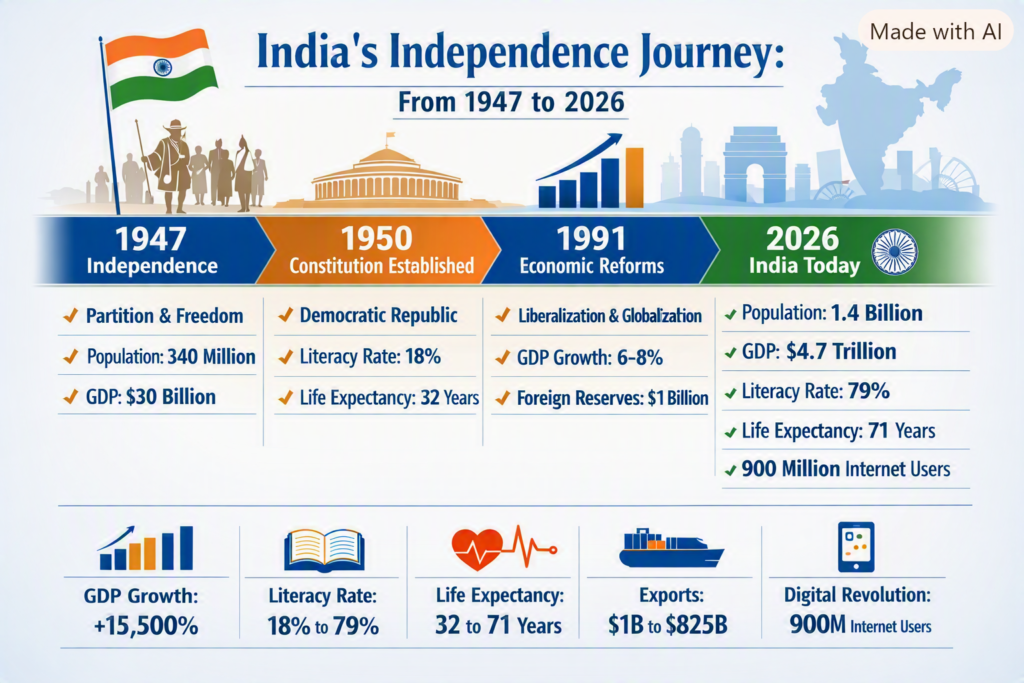
- India’s GDP reached USD 4.7 trillion (2026), ranking fifth globally.
- UPI transactions exceed ₹18 lakh crore monthly, symbolizing digital empowerment.
💡 Social Transformation After India Independence
Education and Literacy
- Literacy rate rose from 18% (1951) to 79% (2026).
- India now has 1,100+ universities and 40 million students in higher education.
Health and Life Expectancy
- Life expectancy increased from 32 years (1947) to 71 years (2026).
- Infant mortality dropped from 146 per 1,000 births to 27 per 1,000 births.
Gender and Social Equity
- Women’s participation in the workforce rose to 29%, and 33% reservation in Parliament is set to begin post‑delimitation.
- Schemes like Beti Bachao Beti Padhao and PM Ujjwala Yojana improved social indicators.
🌍 India Independence and Global Standing
Foreign Policy Evolution
- Non‑Alignment Movement (NAM) in the 1950s positioned India as a moral leader.
- Post‑1991, India pursued strategic autonomy, balancing relations with the US, Russia, and China.
- In 2026, India chairs the Global South Forum, advocating equitable development.
Defense and Strategic Capabilities
- India is the fourth‑largest military power, with USD 81 billion defense budget (2026).
- Indigenous programs like Tejas, INS Vikrant, and Agni‑V missiles reflect technological maturity.
Space and Science
- ISRO launched Chandrayaan‑3 (2023) and Gaganyaan (2025), marking India’s entry into human spaceflight.
- India’s space economy projected to reach USD 40 billion by 2030.
🏙️ Economic Data Snapshot Since India Independence
| Indicator | 1947 | 2026 | Growth |
|---|---|---|---|
| GDP (USD) | 30 Billion | 4.7 Trillion | +15,500% |
| Literacy Rate | 18% | 79% | +61 points |
| Life Expectancy | 32 yrs | 71 yrs | +39 yrs |
| Exports | USD 1 Billion | USD 825 Billion | +824× |
| Foreign Reserves | USD 1 Billion | USD 650 Billion | +649× |
| Internet Users | 0 | 900 Million | Digital revolution |
🔎 Analytical Perspective: The Meaning of Independence Today
Economic Independence
India Independence now means economic sovereignty — the ability to make policy decisions free from external pressure.
- India’s Atmanirbhar Bharat initiative promotes domestic manufacturing.
- Renewable energy capacity crossed 200 GW, reducing import dependence.
Technological Independence
- India’s semiconductor mission and AI policy 2026 aim to secure digital autonomy.
- Indigenous 5G rollout and satellite networks strengthen national infrastructure.
Cultural Independence
- Revival of Indian languages, heritage sites, and traditional crafts under Ek Bharat Shreshtha Bharat.
- Global recognition of Yoga Day and Ayush medicine reflect soft‑power expansion.
⚖️ Challenges Ahead
1. Inequality and Urbanization
- Top 10% hold 77% of national wealth (Oxfam 2025).
- Rapid urbanization strains housing and infrastructure.
2. Climate and Sustainability
- India is the third‑largest carbon emitter, yet leads in renewable energy growth.
- Balancing industrial expansion with environmental protection remains critical.
3. Governance and Federal Balance
- Regional disparities persist; southern states demand equitable representation post‑delimitation.
- Strengthening local governance and transparency is essential for inclusive growth.
📊 India Independence in Numbers (2026 Perspective)
| Sector | Key Metric | Source |
|---|---|---|
| GDP Growth | 7.4% (2026) | IMF World Economic Outlook |
| Inflation | 1.7% (2026) | RBI Annual Report |
| Exports | USD 825 Billion | Ministry of Commerce |
| Renewable Energy | 200 GW Installed | MNRE 2026 |
| Digital Transactions | ₹18 Lakh Crore Monthly | NPCI Data |
| Literacy | 79% | Census Projection 2026 |
Conclusion: India Independence as a Living Idea
India Independence is not a static event of 1947 — it is a living idea that continues to evolve. From political freedom to economic sovereignty, from digital empowerment to global leadership, independence today means the ability to chart India’s destiny on its own terms.
As India approaches Viksit Bharat 2047, the meaning of independence will expand further — encompassing sustainability, innovation, and inclusivity. The journey from colonial subjugation to global leadership is proof of India’s resilience and vision.
Follow FreeStrikes for more insights on India’s policy shifts.
🔗 You may also read:
India Growth Story 2026
1 thought on “India Independence: From Colonial Struggle to Global Leadership”