
Introduction : SpaceX Rocket Moon Crash
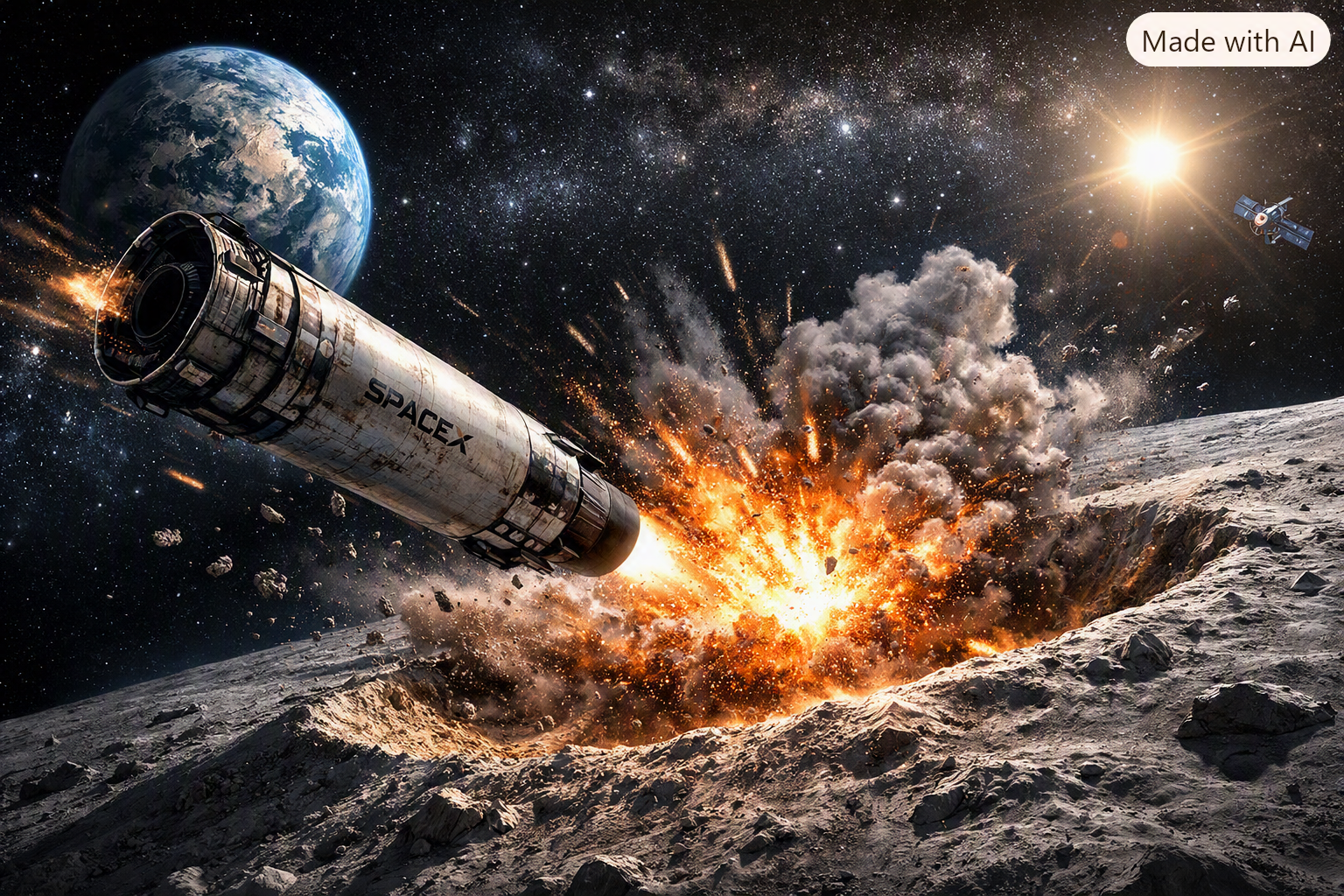
The SpaceX rocket moon crash in August 2026 has become a trending topic in global space news. A spent Falcon 9 upper stage, left adrift after completing its mission, eventually collided with the Moon at extraordinary speed. While the incident posed no threat to Earth, it has sparked scientific curiosity about lunar impacts and raised serious questions about space debris management in deep space.
Details of the Incident
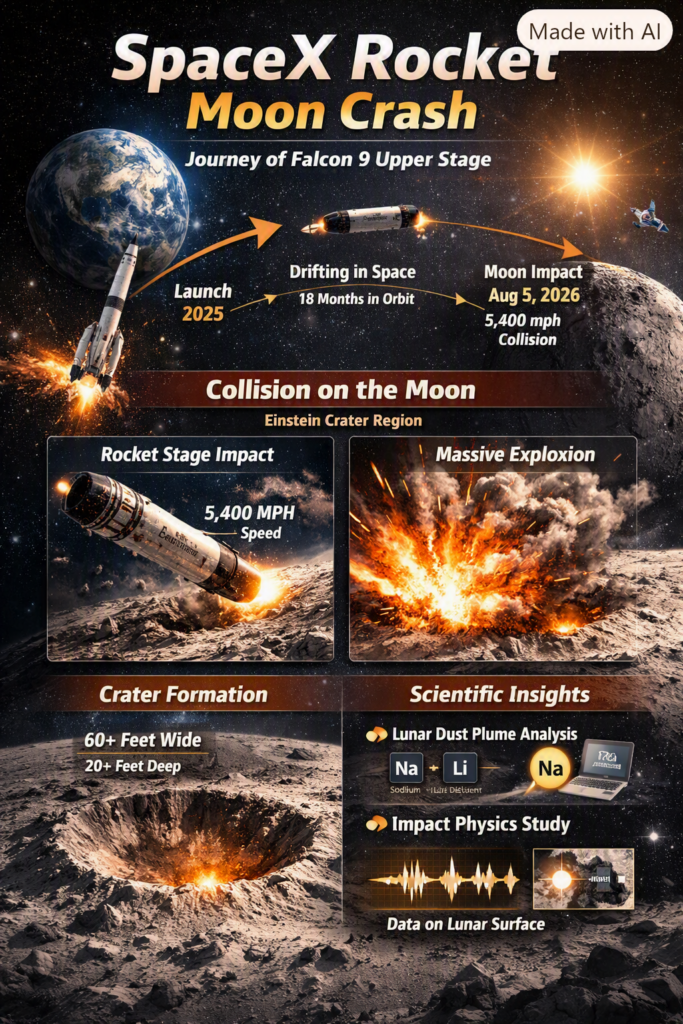
The rocket stage involved was part of a Falcon 9 launch in January 2025, which carried payloads for lunar exploration. After completing its mission, the upper stage had no remaining fuel to maneuver into a safe disposal orbit. Over the course of 18 months, gravitational forces from Earth, the Moon, and the Sun gradually altered its trajectory. On August 5, 2026, the four‑tonne stage struck the Moon near the Einstein crater at a speed of nearly 5,400 mph (8,700 km/h). The impact energy was equivalent to several tons of TNT, creating a new crater on the lunar surface.
Scientific Significance
The crash provided scientists with a rare opportunity to study high‑velocity impacts on the Moon. The newly formed crater, estimated to be 18–27 meters wide and several meters deep, offers insights into lunar geology and regolith behavior. Instruments detected a plume of dust and gases, including sodium and lithium, which may help researchers better understand the composition of both lunar soil and rocket materials. South Korea’s Danuri spacecraft captured before‑and‑after images of the site, while NASA’s Lunar Reconnaissance Orbiter is expected to provide detailed mapping.
Historical Context
This is not the first time a rocket has unintentionally crashed into the Moon. In 2022, a Chinese rocket stage created a double crater on the lunar surface, surprising scientists. Earlier, during the Apollo era, NASA deliberately crashed rocket stages into the Moon to study seismic activity. However, the SpaceX rocket moon crash highlights a growing issue: the increasing amount of hardware left in unstable orbits around the Earth‑Moon system.
Space Debris Debate
The incident has reignited debate about space debris management. While low‑Earth orbit already faces challenges from thousands of defunct satellites and rocket bodies, deep‑space missions add another layer of complexity. Unlike Earth orbit, there are no strict international guidelines for disposing of hardware sent toward the Moon or beyond. Critics argue that without proper disposal protocols, future lunar missions could face hazards from uncontrolled debris. Supporters counter that such crashes, while unplanned, can provide valuable scientific data.
Current Relevance
The SpaceX rocket moon crash is relevant today for several reasons. First, it underscores the need for international cooperation on space debris policies, especially as more nations and private companies plan lunar missions. Second, it provides a scientific opportunity to study impact physics, which could inform both planetary defense strategies and future lunar exploration. Finally, it captures public imagination, symbolizing both the risks and rewards of humanity’s expanding presence in space.
Conclusion
The SpaceX rocket moon crash of August 2026 is more than just a headline—it is a reminder of the challenges that come with ambitious space exploration. While the impact created a new crater and offered scientists valuable data, it also highlighted the urgent need for better space debris management. As humanity prepares for a new era of lunar bases and deep‑space missions, balancing exploration with responsibility will be critical.