
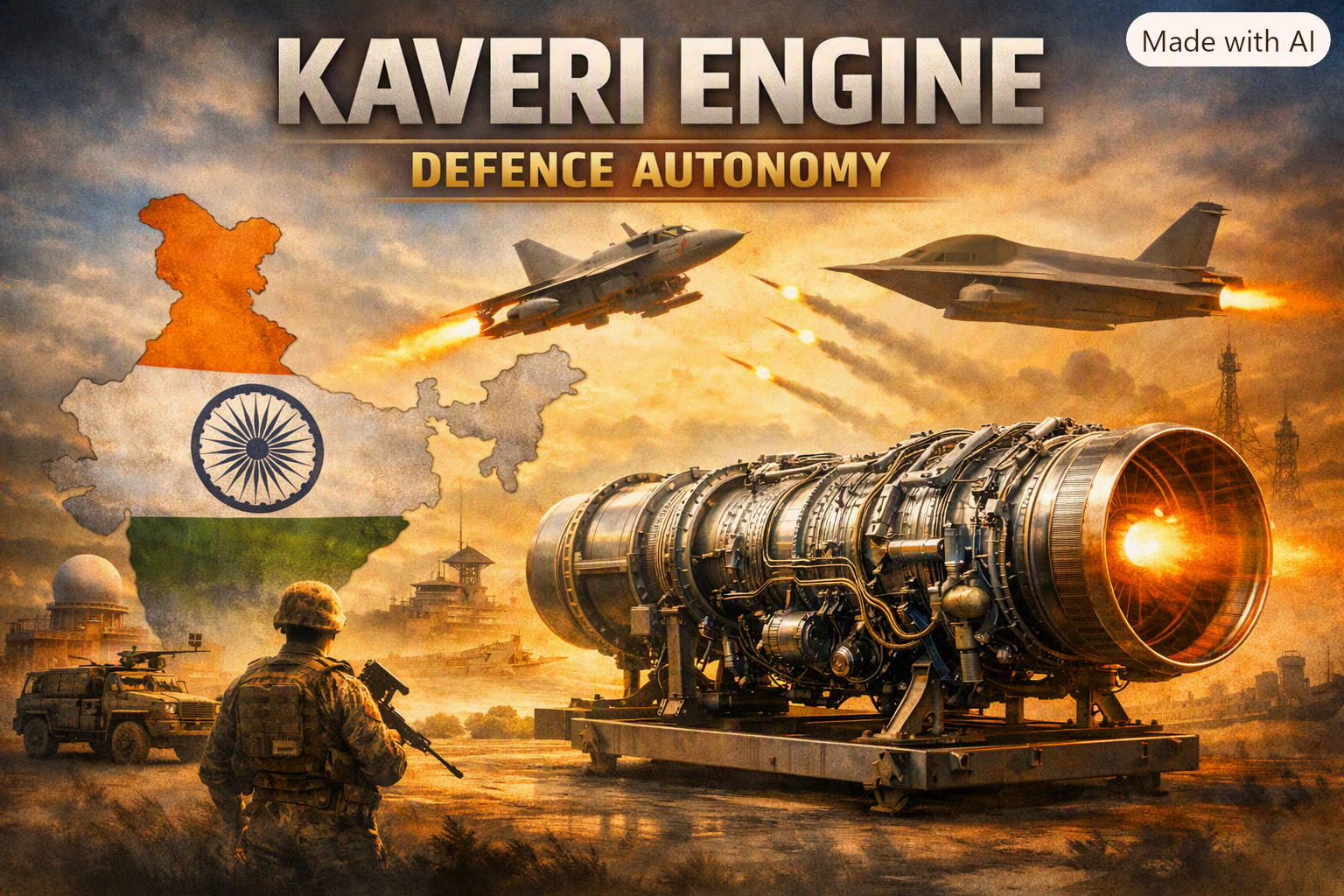
India’s indigenous fighter jet engine program, the Kaveri Engine 2.0, has entered a decisive new phase in August 2026, with breakthroughs in thrust, weight reduction, and advanced materials. The Gas Turbine Research Establishment (GTRE) is now targeting integration into Tejas variants by 2030, marking a milestone in India’s aerospace self‑reliance.
🛠️ The Kaveri Engine Journey
1980s – Project Launch
- 1986: GTRE begins work on the indigenous Kaveri jet engine.
- Aim: Reduce dependence on imported turbofans for the Light Combat Aircraft (LCA) program.

2000s – Initial Tests of Kaveri Engine
- 2004: First ground and flight trials conducted.
- Outcome: Engine produced ~41 kN dry thrust and ~70–72 kN wet thrust, falling short of requirements.
- Result: Reliance on imported GE F404 engines for Tejas Mk1 fighters.

2010s – Setbacks and Redesign :Kaveri Engine
- Persistent issues with weight (1,235 kg) and thrust performance.
- Program split from LCA in 2008, leading to delays and partial spin‑offs (marine gas turbines).
2020s – Revival and Breakthroughs

Kaveri Engine 2.0 Achievements
- Weight Reduction: Down to ~1,100 kg, with future prototypes aiming below 1,000 kg.
- Thrust Performance: 55–59 kN dry thrust, 90–100 kN wet thrust with afterburner.
- Advanced Materials: Single‑crystal turbine blades, polymer composites, BLISK compressors.
- Digital Upgrades: FADEC systems, boltless turbine blades, digital twin modeling.
🚀 Strategic Importance
- Tejas Mk1A & Mk2: Designed to replace GE engines during mid‑life upgrades.
- AMCA & Ghatak UCAV: Future integration planned, alongside a heavier 120–140 kN engine co‑developed with Safran.
- Self‑Reliance: Ends dependence on foreign suppliers, especially amid global supply chain delays.
📊 Comparison: Original Kaveri Engine vs Kaveri 2.0
| Feature | Original Kaveri | Kaveri 2.0 |
|---|---|---|
| Dry Thrust | 41 kN | 55–59 kN |
| Wet Thrust | 70–72 kN | 90–100 kN |
| Weight | ~1,235 kg | ~1,100 kg (target <1,000 kg) |
| Materials | Conventional alloys | Single‑crystal blades, composites |
| Control | Basic FADEC | Advanced FADEC + digital twin |
⚠️ Challenges Ahead
- Certification Timeline: Dry derivative engines to be tested on unmanned platforms first.
- Reliability: Long endurance trials required to match imported engines.
- Production Scale: Needs investment and private sector participation for mass rollout.
- How Kaveri 2.0 Will Boost India’s Defence Autonomy
The Kaveri 2.0 engine is more than a technological milestone — it’s a strategic leap toward defence autonomy. By mastering indigenous jet propulsion, India reduces its reliance on foreign suppliers such as GE and Safran, ensuring that critical fighter programs like Tejas Mk2, AMCA, and Ghatak UCAV remain unaffected by external sanctions or supply‑chain disruptions.
This independence strengthens India’s sovereign control over its air‑power capabilities. Every locally produced engine means fewer import dependencies, lower maintenance costs, and faster upgrades tailored to Indian operational needs. The Kaveri 2.0’s modular design also allows integration into multiple platforms — from fighters to drones — creating a unified propulsion ecosystem across the Indian Air Force and Navy.
In the long term, the program will expand India’s defence arsenal, enabling the country to export indigenous aircraft and propulsion systems to friendly nations. This not only enhances India’s geopolitical influence but also fuels domestic manufacturing under Atmanirbhar Bharat, positioning India as a global hub for advanced aerospace technology.
📝 Conclusion : Kaveri Engine Future?
The Kaveri 2.0 program is India’s boldest step toward aerospace independence. With thrust levels comparable to imported engines, reduced weight, and advanced materials, it is poised to power Tejas upgrades and future AMCA fighters. While certification and scaling remain hurdles, the latest breakthroughs mark a turning point in India’s defense technology.