
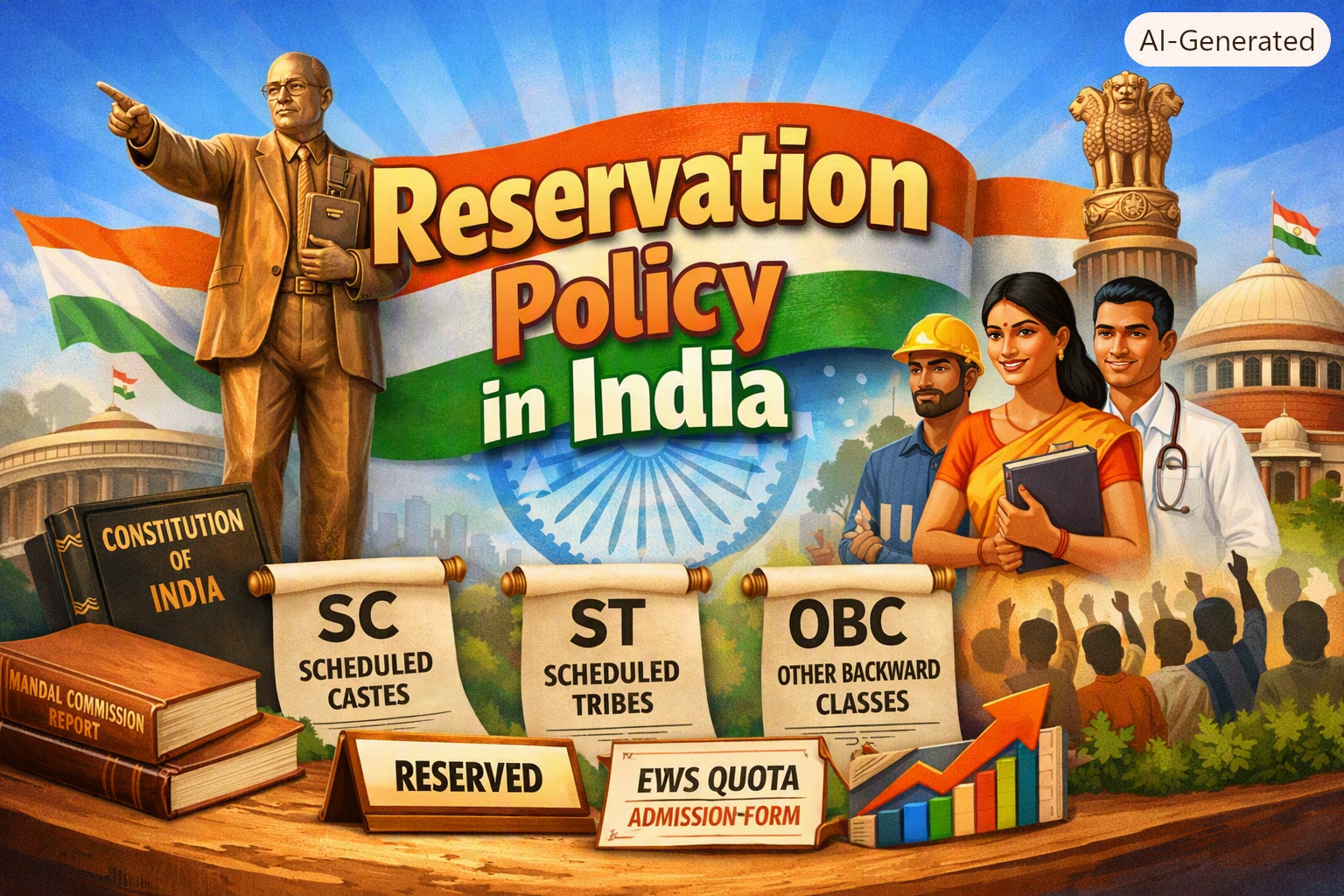
Introduction: Reservation policy in India
The reservation policy in India is one of the most defining features of its constitutional framework. Designed to correct historical injustices and ensure representation for marginalized communities, it has shaped education, employment, and politics for decades. While the constitutional validity of reservation has been upheld by the Supreme Court, the history of reservation in India shows continuous expansion and reform. Today, debates focus on its future — balancing social justice with merit and economic criteria.
📜 Background of Reservation Policy in India
The reservation policy in India has roots in the pre‑Independence era. In 1902, Shahu Maharaj of Kolhapur introduced 50% reservation for backward classes in his state’s services, marking one of the earliest affirmative action measures. Later, the Government of India Act 1935 provided reserved seats for Scheduled Castes in legislatures.
After Independence, the framers of the Constitution recognized the need to uplift Scheduled Castes (SCs), Scheduled Tribes (STs), and later Other Backward Classes (OBCs). Thus, the reservation policy in India was enshrined as a constitutional mechanism to ensure equality of opportunity.
⚖️ Constitutional Validity of Reservation
The constitutional validity of reservation rests on explicit provisions:
- Article 15(4) & 15(5): Allow special provisions for socially and educationally backward classes in education.
- Article 16(4): Permits reservation in public employment.
- Articles 330–342: Provide political representation for SCs and STs in legislatures.
- Directive Principles (Article 46): Direct the state to promote educational and economic interests of weaker sections.
Judicial interpretation has refined the scope of reservation:
- Indra Sawhney v. Union of India (1992): Upheld OBC reservations but capped total quotas at 50% and introduced the “creamy layer” concept.
- Kesavananda Bharati v. State of Kerala (1973): Affirmed that reservation cannot violate the “basic structure” of the Constitution.
🔗 Constitution of India – Ministry of Law & Justice (legislative.gov.in) (legislative.gov.in in Bing)
📖 History of Reservation in India
The history of reservation in India reflects its gradual expansion:
- 1950s: Reservation for SCs and STs in education and jobs (22.5%).
- 1979: Mandal Commission recommended 27% reservation for OBCs, implemented in 1990.
- 2005 (93rd Amendment): Extended reservations to private educational institutions.
- 2019 (103rd Amendment): Introduced 10% quota for Economically Weaker Sections (EWS), based on income rather than caste.
🔗 PIB – 103rd Constitutional Amendment (EWS Quota) (pib.gov.in) (pib.gov.in in Bing)
🔮 Future of Reservation Policy in India
The future of reservation policy in India will be shaped by several factors:
- Caste Census 2026: Updated data will enable rational sub‑categorization of OBCs and better targeting of benefits.
- Creamy Layer Enforcement: Stronger implementation will ensure benefits reach the truly disadvantaged.
- Economic Criteria: The EWS quota signals a shift toward hybrid models combining caste and income.
- Sunset Clauses: Policy experts argue for time‑bound reservations to prevent permanent dependency and preserve merit.
🔗 PIB – Government Statements on Reservation Policy (pib.gov.in) (pib.gov.in in Bing)
✍️ Conclusion
The reservation policy in India has been a cornerstone of social justice, enabling representation and opportunity for marginalized groups. Yet, it faces challenges of over‑expansion, political misuse, and merit concerns. The constitutional validity of reservation ensures that it remains lawful only under quantifiable data, sub‑50% limits, and creamy layer exclusions.
Looking ahead, the history of reservation in India shows that it has always adapted to social realities. Its future will likely evolve into a data‑driven, economically sensitive model, balancing equity with efficiency.
1 thought on “Reservation Policy in India: The Great Indian Dilemma”